

STREAK CONTINUESWisconsin football drops its 10th straight Big Ten gameSPORTS. C1
STREAK CONTINUESWisconsin football drops its 10th straight Big Ten gameSPORTS. C1
STREAK CONTINUESWisconsin football drops its 10th straight Big Ten gameSPORTS. C1
STREAK CONTINUESWisconsin football drops its 10th straight Big Ten gameSPORTS. C1
Tellurian CEO Kevin Florek told Dane County officials the non-profit would not renew its contract to manage the county's detoxification progra…
Dane County’s detoxification center has been a resource for police officers and sheriff’s deputies for nearly four decades. But at the end of 2025, without renewed talks between county officials and the company that runs it, that tool to handle the region’s intoxicated will be gone.
On Oct. 17, four police chiefs representing the Madison, Sun Prairie, Middleton and UW-Madison departments sent a letter to Dane County Executive Melissa Agard imploring her and county government to work out a deal to keep Tellurian Behavioral Health’s detox center open.
“We view this as a looming disaster and every resident in Dane County should be concerned,” the chiefs wrote to Agard. “This change will reduce the time our officers and deputies are available to respond to other calls for service and emergencies and will adversely impact our overtime budgets. This seems unacceptable and avoidable.”
In September, Tellurian Behavioral Health, the nonprofit that operates Dane County’s detox center, gave a 90-day notice that it would not renew its contract with the county.
The county pays Tellurian about $1.2 million a year for the detox program. But according to Tellurian, the detox program has been hemorrhaging money for the past two years, costing Tellurian more than $750,000 in 2024, primarily due to underfunding from the county.
The county paid about $400 a day for detox services last year. But for Tellurian to break even, the county would have had to pay about $750 a day, an amount already too low to keep up with rising staff costs, Tellurian CEO Kevin Florek previously told the Wisconsin State Journal, noting that Tellurian paid more than $300,000 for contract nurses last year to meet state minimum staffing requirements.

Tellurian lost more than $773,000 in 2024, with 75% of that due to the county’s underfunding, CEO Kevin Florek said.
Facing a $31 million budget deficit, though, Dane County has entered a period of austerity, as government departments have had to find 4% cuts.
In 2024, more than 700 people were brought to the detox center by law enforcement officers in Dane County. In 2025, there have been more than 400 drop-offs, according to the Dane County Chiefs of Police Association.
Regardless of budget problems, however, the county is responsible for providing emergency treatment services to people incapacitated by drugs or alcohol, according to Wisconsin statutes. But there’s flexibility in deciding what that treatment looks like.
In the place of detox, the county may shift its focus to a more voluntary model for individuals actively seeking drug and alcohol addiction treatment, said Todd Campbell, head
of Dane County Department of Human Services’ Behavioral Health Division.
“We understand that that’s going to be a shift for our community, but it’s the way in which a lot of other communities are looking at this issue,” Campbell said. “It’s become too costly for us to duplicate medical care in a community-based setting solely with county tax levy dollars.”
But law enforcement officials say the new model isn’t an adequate replacement for detox, which treats people who are unable to seek it out themselves. .
When police or sheriff’s deputies are called to pick up an inebriated person, that person is brought to the detox center, the drop-off takes around 20 minutes, and staff monitor the sobering process.
Without detox, individuals will have to be taken to a hospital emergency room or the jail, a process that can take hours, Madison Police chief John Patterson told the Wisconsin State Journal.
Medical staff in Dane County are already strained, especially in rural areas, Public Health Madison and Dane County spokesperson Morgan Finke said.
“Without having access to medically supervised detox, we do know that there is an increased risk of death in our most vulnerable neighbors, when people try to manage withdrawal symptoms by themselves or at home,” Finke said.
Patterson said officers would have to spend more time dealing with intoxicated individuals if their only alternative is to go to an emergency room or the county jail, accruing more overtime and driving up municipal police department budgets.
“I understand, probably better than most chiefs, the budgetary constraints that we’re being faced with,” he said. “But it just feels like we’re just passing the costs off (to) other areas.”
Florek has estimated that, instead of spending around 20 minutes to drop someone off at detox, law enforcement could spend four to six hours at hospitals while they wait for people to sober up.
Asked about the burden that closing detox could have on other government entities, Agard told the State Journal that the county is an extension of the state and “we need good partners at the federal and at the state level to meet us and meet our community at what our values are.”

Breaking down the numbers that may lead to the end of Dane County’s detox program.
“There are 60 municipalities in Dane County, and everyone is struggling,” she said. “And at the same time, we’ve got a state government that’s sitting on a multi-billion-dollar rainy day fund, and we have a federal government that is ensuing chaos on our communities every single day.”
Tellurian and the county have engaged in discussions since the start of the year about how to keep detox running, with suggestions from scaling down the number of beds and staff to increasing the amount of money going to the program.
“In February, they reached out to the county to talk about financial struggles,” Agard said. “And I believe this is the first time that we were made aware of these financial struggles.”
During a meeting last month, she said, the two side were nearing an agreement. “It was after that meeting when we thought we had a few more i’s to dot and t’s to cross that Tellurian put out a memo saying that they plan to cancel.”
But Tellurian CEO Florek said that account of events is not true. “They’re acting surprised, ‘Oh, we just found out about this.’ They get our audit every year, they see it.”
According to Florek, the county shot down most of Tellurian’s plans to make the detox program financially viable.
“There’s no solutions, no suggestions, and ‘Oh, by the way, we’re going in a different direction in 2026,’ so it’s like, OK, we’re out,” he said. “They don’t want this level of care, and they have big cuts coming up, and they can pass this expense on to police and the ERs.”
Tellurian’s detox contract is up at the end of December, and the county is seeking bids from companies to run a voluntary alternative program.
By the time Monty Lilford received a call from the American consulate in Cape Town in February, he had only days to get from his home in South Africa’s Western Cape to Wisconsin’s Driftless Area. If all went according to plan, the 35-year-old mechanic would spend the next nine months as a do-it-all farmhand, joining the thousands of seasonal agricultural workers seeking better wages in Wisconsin through the H-2A visa program.
Lilford could not afford a last-minute flight halfway across the world, so he turned to his father-in-law for help.
“I begged him,” he said. “I needed to go.”
The temporary visa program offered Lilford a chance to build a middle-class life back home, albeit one that requires spending much of the year sharing a modest ranch house with seven fellow farmworkers near Fountain City. His visa does not offer him a pathway to legal permanent residency in the United States, and he will be barred from the program if he overstays.
Mike Bushman, Lilford’s employer and the owner of B&B Agri Sales in Buffalo County, considers the program the only legal and reliable source of labor for his farm. While he could hire workers who lack legal status, Bushman is wary of the risks.
“You work your whole life to put something together and then take the risk of losing it all,” he said.
The H-2A program comes with higher up-front costs, he explained, but he considers it essential to keep his farm afloat amid a labor shortage.
Bushman is not alone. The number of seasonal workers hired by Wisconsin farmers through the H-2A program has increased six-fold over the past decade, according to 2024 state Department of Workforce Development data. The surge began long before President Donald Trump returned to office in January. Amid the White House’s ongoing immigration crackdown, however, some farmers now consider the program an even more critical alternative to workers without legal status.
The program is far from a flawless solution to the agricultural sector’s labor crisis.
For farmers, the H-2A application process is often an expensive, slow-moving headache — one they must relive year after year.
Workers, meanwhile, frequently report wage theft and other mistreatment, and the U.S. Department of Labor’s Wage and Hour Division routinely uncovers violations of H-2A rules on Wisconsin farms. With inspectors stretched thin, patterns of abuse and fraud can go unpunished for years. Workers who walk away from a dishonest employer or dangerous workplace risk losing their visa.
The Trump administration has introduced a litany of adjustments to the program’s rules in recent months, including cuts to minimum wages and a yet-to-be-implemented $250 fee per visa. With some details still hazy, farmers and workers are awaiting clarity on what lies ahead.
Farmers argue the program is rife with inefficiencies. Program staff are often difficult, if not impossible, to reach, the application process relies almost entirely on physical mail, and farmers regularly spend thousands of dollars on attorneys to help navigate the labyrinth of paperwork. Keeping an application moving on schedule is a “constant battle,” Bushman said.
The application requires approval from multiple federal and state agencies, often resulting in delays during handoffs from one agency to another. Those hurdles and screening interview backlogs at American consulates and embassies can leave workers stuck in their home countries past the planned start of their contract.
“Last year, the workers came almost three days late,” said Adam Lauer, co-owner of a pickling cucumber farm in Waushara County. “At three days late, you’re throwing a lot of pickles away.”
Bushman said such delays were responsible for Lilford’s last-minute rush to secure a plane ticket — a systemic flaw loan sharks exploit by charging desperate workers extortionate interest rates, he added.
Earlier this month, the Trump administration took steps to address some delays, allowing U.S. Citizenship and Immigration Services to begin reviewing workers’ applications while the Department of Labor considers applications from employers. That could buy more time for workers to schedule screening interviews at consulates and embassies, said Tom Bortnyk, senior vice president and general counsel for Virginia-based másLabor, which provides H-2A recruitment and application services for farmers nationwide, including in Wisconsin.
Other hurdles are tougher to fix. Federal regulators can be slow to send crucial paperwork, said Ethan Olson, a labor contractor who works with Lauer. That can leave farmers without documentation required — at least in theory — to prove they comply with H-2A rules. “You’re at the government’s mercy,” he said.
The Department of Labor did not respond to a request for comment during the ongoing government shutdown.
Wisconsin’s H-2A workforce is smaller than those of its neighbors, in part because the seasonal visa program is largely off-limits to the year-round dairy industry, which plays an outsized role in state agriculture. Michigan farmers hired roughly 15,000 H-2A workers in 2024, compared with fewer than 3,000 in Wisconsin.
Wisconsin’s H-2A workers spent the summer picking celery near Janesville, driving farm equipment in Fond du Lac County and tending pheasants outside of Marshfield. Lilford spent an October afternoon bundling equipment in Bushman’s fabrication shop while another farmhand moved feed corn into storage.
In years past, at least some of those jobs went to workers without legal status. “We went down to Florida to recruit,” Lauer said. Between 2021 and 2022, roughly 42% of crop workers surveyed lacked work authorization.
Lauer noted practical reasons to switch to an H-2A workforce. “We were so short on people,” he said. “Multiple years, 20 to 30 people short.” By the time his farm needed workers in mid-summer, many undocumented farmworkers had already found jobs elsewhere.
Hiring undocumented workers also comes with legal risks. If caught, employers face fines of up to $3,000 per worker. Amid a nationwide immigration enforcement crackdown, Lauer said, “I wouldn’t take that chance.”
Elsewhere in Wisconsin, some farmers turned to the program as local alternatives slipped away.
Before 2019, Dan Hanauer largely hired in and around Shawano for seasonal jobs on his Christmas tree farm. Some local workers were out of high school; others arrived through a county jail employment program.
By law, employers must offer seasonal jobs to “qualified, eligible U.S. workers,” including past employees, before hiring H-2A workers. In the past six months, prosecutors in Mississippi and Washington state have scrutinized employers accused of prioritizing H-2A workers over U.S. workers.
Hanauer argues he was forced to switch. His local workforce, he said, was dwindling and prone to missing shifts.
“The job description says you miss three days and you’re gone,” he added.
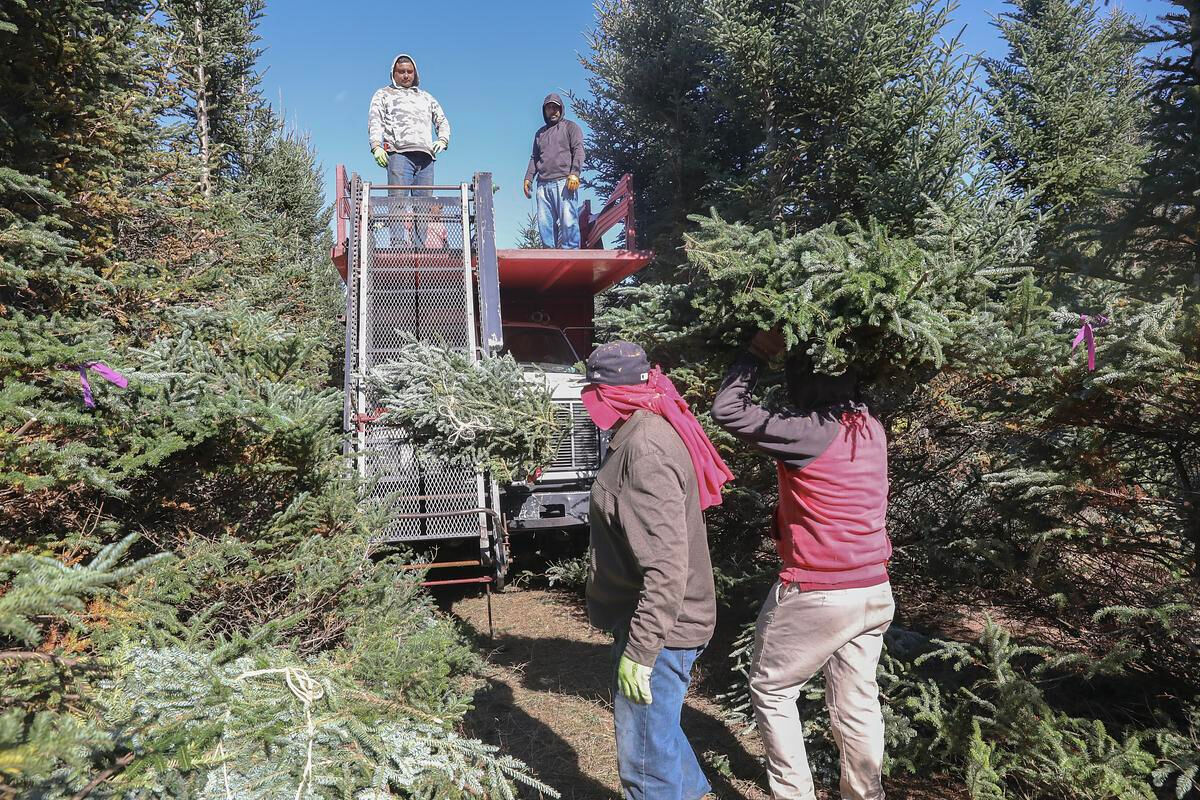
On a recent weekday morning, several H-2A workers cut boughs from the bases of fir trees to be sold as Christmas wreaths — a new product for his business made possible by a more reliable team of seasonal workers from Mexico, Hanauer said.
Most of the roughly 20 H-2A workers who spoke to Wisconsin Watch — all employed by either Bushman, Lauer or Hanauer — were from Mexico.
Upon returning to Mexico, “I take a week off to rest, and then it’s back to work,” said Israel Cruz, a construction worker who spent much of the summer picking cucumbers on Lauer’s farm in Waushara County.
Mexican nationals made up over 90% of the H-2A workforce last year, often traveling by van to and from farms in communities like Shawano. This year, a handful of Hanauer’s workers flew to Appleton instead.
South Africans make up the second-largest nationality in the H-2A workforce, as they have for much of the past two decades. They outnumbered Jamaican workers, the next-largest cohort, more than 3-to-1 last year.
Lilford, like the other members of Bushman’s crew, is an Afrikaner — a descendant of early Dutch, French and German settlers. Data on the nationalities of visa recipients does not specify ethnicity, but labor contractors who recruit in South Africa say most H-2A workers from the country are white.
To theoretically avoid undercutting U.S. farmworker wages, the Department of Labor sets a minimum wage for H-2A workers. This year, Wisconsin H-2A employers must pay at least $18.15 an hour, up from $14.40 in 2020. The program also requires employers to pay for housing and transportation and to reimburse travel to and from workers’ home countries, none of which is required when hiring local farmworkers.
The Department of Labor announced cuts to the program’s minimum wage in early October, responding to farmers’ complaints about rising labor costs.
In a preamble to the new rule, the agency argued that the cost of participating in the H-2A program has become “increasingly burdensome” — surpassing the cost of hiring U.S. workers if they were available. The agency also noted that a decline in the number of undocumented agricultural workers will “deprive growers of a relatively cheaper labor supply,” pushing more farmers to the H-2A program.
The new rules reverse a 2023 Biden administration decision requiring farmers to pay H-2A workers based on the specific duties they perform. Some roles, like veterinary medicine and truck driving, required higher wages than standard field work, and farmers were obligated to pay according to the highest-earning role employees performed, even if it was not their primary role.
That standard prompted legal challenges from H-2A employers, including Bushman, who joined a federal class action lawsuit challenging the rule earlier this year. A federal judge in Louisiana vacated the rule in August after a sugar cane growers’ association brought a separate lawsuit.
Instead, the Department of Labor’s new rule divides H-2A workers into two “skill levels” based on the experience and training required for their job.
The department will also now allow employers to deduct a portion of workers’ hourly wages for housing costs, which the agency argues will even the playing field for domestic farmworkers.
Wisconsin workers classified as less-skilled could receive as little as $12 per hour next year under the new standards — a reduction of 34% from the current H-2A minimum wage.
“In the countries where they’re recruiting, people are desperate enough to take a job for less than the prevailing wage,” said Jose Oliva, campaign director with HEAL Food Alliance, a national group that organizes and advocates for food supply chain workers.
New H-2A minimum wages are higher in every state neighboring Wisconsin. In Michigan and Illinois, H-2A workers will be paid at least their state minimum wage, exceeding the federal program minimum.
Program wages have always varied from state to state, said Bortnyk of másLabor. The latest changes, however, create a “meaningful enough difference” to fuel steeper recruiting competition for Wisconsin farmers.
For Bushman, that competition is reason enough not to cut wages. The lower minimum “won’t save us anything,” he said, because retaining experienced crew members makes more business sense than training new hires.
The minimum wage changes follow the Trump administration’s decision in June to suspend enforcement of Biden-era rules intended to crack down on H-2A abuses.
Among other protections, those rules previously guaranteed that workers could invite guests like legal aid providers and clergy into employer-provided housing. In Wisconsin, H-2A workers retain that right through the state’s migrant labor law.
Wisconsin farmers are well aware of the opportunities for exploitation.
Lauer recalled discovering that a recruiter in Mexico had charged job seekers hundreds of dollars to apply for openings on his farm — a violation of program rules.
“It all happened in Mexico, so we never saw the money,” he added. Lauer says his business cut ties with the recruiter after consular officials in Mexico alerted him of the recruiter’s practices.
None of the workers who spoke with Wisconsin Watch shared firsthand accounts of violations or mistreatment at their current workplaces. However, the Department of Labor has fined 23 Wisconsin H-2A employers for program violations in the past decade.
Auditors cited one labor contractor, Adams County-based J&P Harvest, for more than 650 violations of H-2A program rules between 2019 and 2023. The department approved J&P Harvest’s most recent application in March of this year. The company, which lists a Florida phone number in its contact information, did not respond to a request for comment.
In some cases, the Department of Labor can temporarily ban, or “debar,” farmers and contractors from participating in the program. J&P Harvest does not appear on the agency’s current list of debarred businesses, but Jan Enterprises, a flower-growing business near Green Bay, is currently banned from participating in the program for allegedly hiring H-2A workers in place of American applicants. A related greenhouse is also on the department’s debarment list.
According to a 2015 review by the federal Government Accountability Office and 2023 reporting by Investigate Midwest, loose enforcement of debarments has enabled some businesses to continue hiring through the H-2A program by operating under a new name.
Federal inspectors do not catch every violation. The Wage and Hour Division employed just over 720 investigators to enforce labor laws nationwide last year, according to the Department of Labor’s fiscal year 2025 budget. The agency audited 659 agricultural workplaces last year — less than half the number of audits conducted a decade ago.
Inspectors have recorded H-2A violations by more than half of the 42 Wisconsin agricultural employers audited since 2015, not all of which employ H-2A workers.
“There are other places where you’ll work 10 hours and they’ll pay you for nine,” said Salvador Gonzalez Mosqueda, a veteran member of Hanauer’s crew, recalling warnings about dishonest employers from fellow seasonal workers during an earlier stint in Kentucky.
Some citations were for technical reasons. Lauer Farms, for instance, says it was fined in 2019 for missing date information on pay stubs.
The Trump administration’s signature tax and spending law adds another potential hurdle for workers and employers: a new $250 fee for all nonimmigrant visas, including H-2A.
If federal rulemakers decide workers must pay the fee before entering the country, employers would likely be required to reimburse them. But Oliva warned that enforcement could be weak. “$250 is not chump change” for already vulnerable workers, he added.
It remains unclear whether employers will be eligible for reimbursement from the federal government once their workers return home.
“We’ll just eat another $30,000,” said Lauer, who often hires 120 or more H-2A workers over the course of the year – Wisconsin’s largest crew. While that expense alone won’t bankrupt him, Lauer considers the rising overall costs of participation unsustainable.
“They’ll eventually push us out of business,” he said.
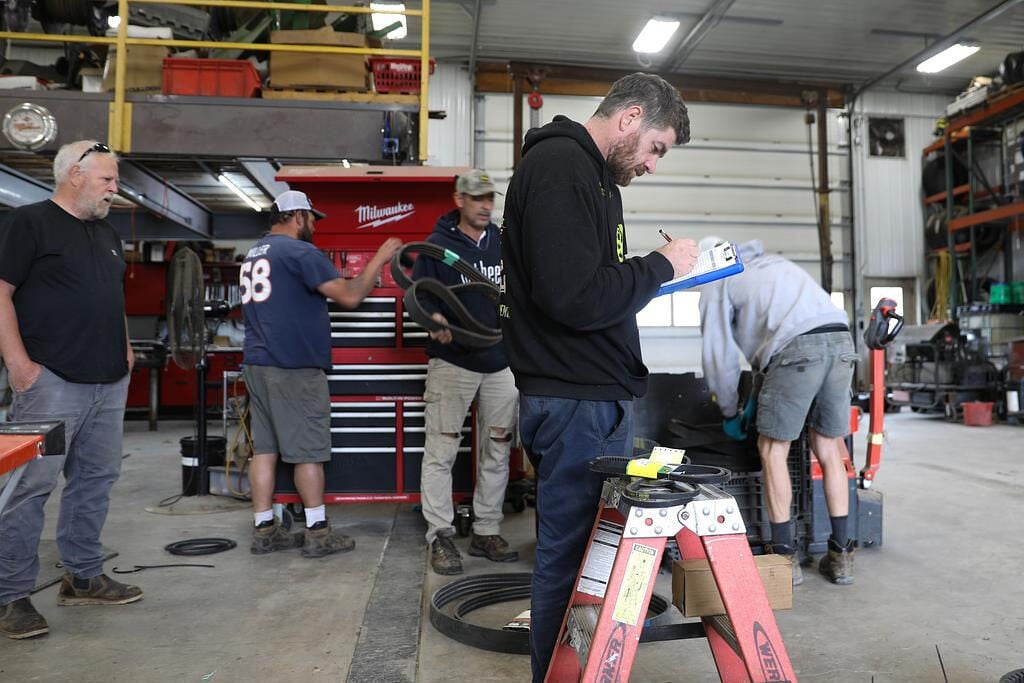
Monty Lilford works in the fabrication shop at B&B Agri Sales in Buffalo County earlier this month.
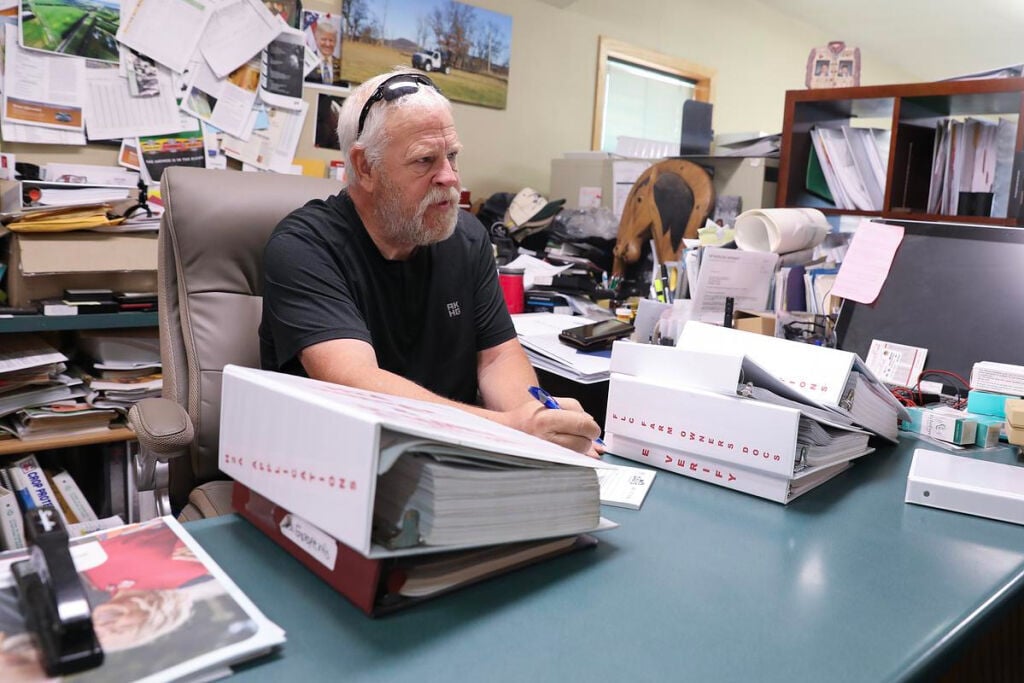
B&B Agri Sales owner Mike Bushman in his office in Buffalo County earlier this month.
Workers with H-2A visas cut fir boughs on a plot rented by Hanauer’s Tree Farms near Shawano earlier this month.
This article first appeared on Wisconsin Watch and is republished here under a Creative Commons Attribution-NoDerivatives 4.0 International License.
ABOARD AIR FORCE ONE — President Donald Trump headed for Asia for the first time this term, a trip on which he is expected to work on investment deals and peace efforts before meeting face-to-face with Chinese President Xi Jinping to try to de-escalate a trade war.
“I think we have a really good chance of making a very comprehensive deal,” Trump told reporters traveling with him on Air Force One. He said he plans to discuss fentanyl trafficking with Xi, as well as China’s lack of soybean purchases from the United States. “I want our farmers to be taken care of. And he wants things also,” Trump said.
The Republican president will use the trip to try to solidify a trade agreement with Malaysia and oversee the signing of an expanded ceasefire between Cambodia and Thailand, after he recently helped broker a ceasefire and hostage agreement between Israel and Hamas.
The two accords could be finalized while Trump attends the annual summit of the Association of Southeast Asian Nations, hosted in Kuala Lumpur. It’s the first stop of a three-country swing across the continent, with visits to Japan and South Korea.
During a refueling stop in Qatar, Trump met briefly aboard his plane Saturday with the ruling emir, Sheikh Tamim bin Hamad Al Thani, and the prime minister, Sheikh Mohammed bin Abdulrahman Al Thani. Trump said they talked about progress on security arrangements in Gaza. “It’s working very well. It’s all smooth. The U.S. doesn’t have to get much involved,” he said.
Trump was set to arrive in Malaysia on Sunday morning, as the U.S. government shutdown drags on.
Many federal workers are set to miss their first full paycheck, there are flight disruptions as already squeezed air traffic controllers work without pay and states are confronting the possibility that federal food aid could dry up. As Republicans reject Democratic demands for health care funds, there’s no sign of a break in the impasse.
“America is shut down and the President is skipping town,” said U.S. Senate Democratic leader Chuck Schumer of New York.
Trump attended the annual ASEAN summit only once during his first term, but this year it comes as Malaysia and the U.S. work to address fighting between Thailand and Cambodia. The two countries have competing territorial claims, and violence periodically flares along their border; dozens of people died and hundreds of thousands were displaced during five days of combat in July. Trump threatened to withhold trade deals with the countries if they didn’t stop fighting.
Trump told reporters aboard Air Force One that he wanted to come because Malaysian Prime Minister Anwar Ibrahim helped resolve the fighting. “I told the leader of Malaysia, who is a very good man, ‘I think I owe you a trip,’” he said.
He and Anwar are scheduled to meet Sunday, followed by the joint signing ceremony with the prime ministers of Thailand and Cambodia.
Trump may also have a significant meeting Sunday with Brazilian President Luiz Inácio Lula da Silva, who wants to see the U.S. cut a 40% tariff on Brazilian imports. The U.S. administration justified the tariffs by citing Brazil’s criminal prosecution of former President Jair Bolsonaro, a Trump ally.
Lula on Friday criticized the U.S. military strikes off the South American coast in the name of fighting drug trafficking. He said he planned to raise concerns with Trump at a meeting Sunday in Malaysia. The White House had not yet publicly confirmed the meeting.
One leader who will be absent from the summit is Indian Prime Minister Narendra Modi. Though he was close with Trump during his first term, the relationship grew tense recently. Trump caused irritation by boasting he settled a recent conflict between India and Pakistan, and he increased tariffs on India for its purchase of Russian oil.
From Malaysia, Trump heads to Japan and South Korea, where he’s expected to make progress on talks for at least $900 billion in investments for U.S. factories and other projects that those countries committed to in return for easing Trump’s planned tariff rates down to 15% from 25%.
The trip to Tokyo comes a week after Japan elected its first female prime minister, Sanae Takaichi. Trump is set to meet with Takaichi, who is a protégé of former Prime Minister Shinzo Abe. Trump was close to Abe, who was assassinated after leaving office. Trump spoke to Takaichi during his flight.
Trump is expected to be hosted by Japanese Emperor Naruhito, and meet with U.S. troops who are stationed in Japan, according to a senior U.S. official who was not authorized to speak publicly and spoke on condition of anonymity.
In South Korea, Trump is expected to hold a highly anticipated meeting with China’s Xi on the sidelines of the Asia Pacific Economic Cooperation summit.
While the APEC summit is set to be held in Gyeongju, the Trump-Xi meeting is expected to take place in the city of Busan, the U.S. official said.
It will follow months of a trade war between China and the U.S. that rattled the global economy. Trump was infuriated after Beijing imposed new export controls on rare earth metals used in technology and threatened to hike retaliatory tariffs.
Trump told reporters Friday that he might ask Xi about freeing Jimmy Lai, a pro-democracy newspaper founder, saying “it’ll be on my list.”